Speaker
Description
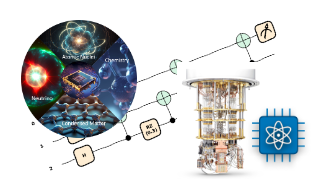
To verify the performance of quantum computers and guide their progress toward scalable implementations achieving quantum advantage for many-body systems, one needs to evaluate performance metrics from the individual sources of noise in qubit hardware to full applications, and one needs to compare the quantum algorithms with the most efficient classical methods. Here we present the QCMet benchmarking software package [1], which implements a comprehensive collection of performance metrics allowing holistic evaluation of quantum computing performance. It is linked to a systematic and consistent set of definitions across all metrics, including a transparent description of the methodology and of the main assumptions and limitations. We then present a hybrid classical/quantum algorithm for the evaluation of Green’s functions of correlated materials, which integrates tensor networks for preparing ground states on classical computers with quantum computers for evaluation of dynamics [2]. For these simulations we use our recently released python tree tensor networks simulation package pyTTN [3]. We conclude by discussing the required development of metrics to address a number of open challenges for quantum computers towards achievement of quantum advantage [1,4].
[1] D. Lall et al., A Review and Collection of Metrics and Benchmarks for Quantum
Computers: Definitions, Methodologies and Software, arXiv:2502.06717;
https://qcmet.npl.co.uk.
[2] F. Jamet et al, Anderson impurity solver integrating tensor network methods with quantum computing, APL Quantum 2, 016121 (2025).
[3] L. P. Lindoy et al., pyTTN: An Open Source Toolbox for Open and Closed System Quantum Dynamics Simulations Using Tree Tensor Networks, arXiv:2503.15460;
https://gitlab.npl.co.uk/qsm/pyttn.
[4] J. Tilly et al., The Variational Quantum Eigensolver: A review of methods and best practices, Phys. Rep. 986, 1 (2022).