Pour vous authentifier, privilégiez eduGAIN / To authenticate, prefer eduGAINeu

Astroparticle Symposium 2025

Europe/Paris
Institut Pascal

Institut Pascal

Rue André Rivière 91400 Orsay
Description

A specialist meeting in Astroparticle Physics that will take place at the Pascal Institute of the Paris-Saclay University for a 3 week program.
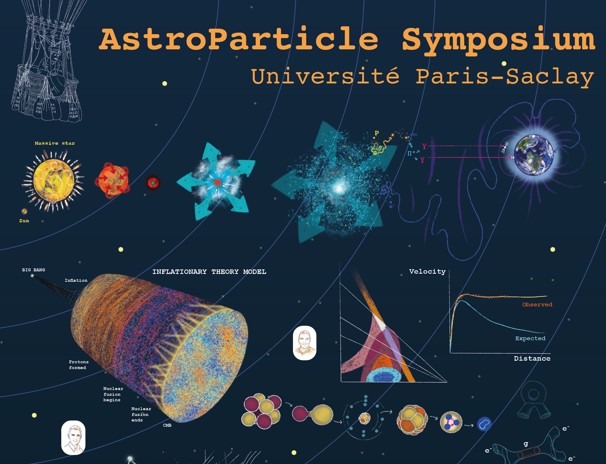
The format will be flexible enough to allow for strong interactions between participants. There will be working sessions every day with dedicated office space for participants a « conference » format day per week with invited speakers.

Scientific Organizing Committee

  • Fabio ACERO (CEA)
  • Xavier BERTOU (IJCLab)
  • Jonathan BITEAU (IJCLab)
  • Philippe BRAX (CEA)
  • François BRUN (CEA)
  • Stephen FEGAN (LLR)
  • Mathieu GROSS (IJCLab)
  • Deirdre HORAN (LLR)
  • Yann MAMBRINI (IJCLab)
Inscription
IPa Registration Form
Participants
Enquêtes
Participants Satisfaction Survey
    • Welcome reception: Welcome and registration to the Direct search for light to ultra-light Dark Matter week
    • Talk: Dark Sector: new technologies
      • 11:00
        Introduction and Coffee Break
      • 1
        Search for dark matter with SNSPDs: the QROCODILE experiment

        The QROCODILE (Quantum Resolution-Optimized Cryogenic Observatory for Dark matter Incident at Low Energy) experiment uses superconducting nanowire single-photon detectors (SNSPDs) to search for scattering and absorption of dark matter (DM) candidates with masses as low as 30 keV. We conducted a first measurement at the University of Zurich with a WSi SNSPD placed on a Si/SiO2 substrate, and we set new world-leading constraints for DM-electron scattering, DM-nucleon scattering and electronic absorption of dark photons. In this presentation I will discuss the working principle, recent results and future plans of QROCODILE.

        Orateur: Chiara Capelli (University of Zurich)
      • 2
        QUEST-DMC: QUantum Enhanced Superfluid Technologies for Dark Matter and Cosmology

        The QUEST-DMC experiment uses a superfluid helium-3 target, cooled to less than 200 microkelvin, to search for interactions with sub-GeV mass dark matter candidates with recoil energies in the keV scale and below. Nanoelectromechanical resonators (NEMS) are submerged in the superfluid target and read out using low-noise quantum sensors to achieve the low energy thresholds required to probe this parameter space. This talk will outline the detector concept, current progress on the experiment and future prospects for sensitivity to dark matter interactions.

        Orateur: Robert Smith
    • Lunch: Welcome lunch at Institut Pascal
    • Science Communication: Meeting with a fashion designer: Panni Margot
    • Talk: Infrastructures
      • 3
        The Modane Underground Laboratory

        The Modane Underground Laboratory is the deepest tunnel-access underground laboratory in Europe. The experimental site is protected by a 4800 m.w.e. overburden that reduce the muon flux to 5 muons/m2/day, and is thus ideal for a wide range of applications requiring ultra-low radioactivity levels. I will present the evolution of this facility and of its science program in the domain of dark matter, neutrinoless double-beta decay and interdisciplinary sciences.

        Orateur: Silvia Scorza
    • Discussion session
    • Welcome reception: Wine and Cheese
    • Talk: Dark Sector: Solid State Detectors
      • 4
        One Electron at a Time: Skipper-CCD and beyond

        Over the past decade, Skipper Charge-Coupled Devices (Skipper-CCDs) have transformed the landscape of rare-event detection by enabling ionization measurements with sub-electron resolution and unprecedented low dark-counts. This capability has opened new windows into the search for low-mass dark matter, coherent neutrino scattering, exotic neutrino interactions, and milli-charged particles. In this talk, I will review the conceptual breakthroughs, experimental milestones, and physics results that have established Skipper-CCDs. Building upon this foundation, a new generation of silicon sensor technologies is emerging. I will discuss key advances in Multi-Amplifier Skipper-CCD (MAS-CCD) architectures, which achieve faster readout while maintaining ultra-low noise; Silicon Sensor with Repeated Operation (SiSeRO) devices, which leverage repeated non-destructive readout in a CMOS-compatible architecture; and Dual-Side CCDs, designed to enhance signal localization and suppress surface backgrounds. I will highlight the scientific opportunities ahead, the challenges that remain, and the possible paths toward next-generation experiments with orders-of-magnitude improvements in sensitivity.

        Orateur: Javier Tiffenberg
      • 5
        Search for millicharged particles with Skipper-CCDs at particle accelerators.

        Millicharged particles (mCPs) appear in many extensions of the standard model. They are characterized by having a fractional electric charge and can be a compelling DM candidate or part of a dark sector that could solve anomalies in both particle physics and cosmology. If mCPs exist, they could be created through meson decays in accelerator facilities. Taking advantage of the low ionization threshold, and the sub-electron noise of Skipper-CCDs, the SENSEI collaboration published results with a small gram-scale detector at the neutrino beamline at Fermilab establishing this technology as an ideal candidate to advance mCP searches with dedicated, more massive experiments. In this talk, I will present the SENSEI result, and discuss other opportunities for mCP searches at accelerator facilities. I will also present the results from a new Skipper-CCD detector installed at the CMS service cavern near the interaction point of the LHC at CERN.

        Orateur: Santiago Perez
      • 6
        The DAMIC-M experiment: light dark matter in a kg-scale Skipper CCD detector

        DAMIC-M (DArk Matter in CCDs at Modane) is an ongoing dark matter (DM) direct detection experiment located at the Modane Underground Laboratory (LSM). The very low energy threshold of Skipper CCDs allows us to test unexplored regions of the DM parameter space, in particular MeV-scale particles which interact with electrons via a U(1) mediator. Using a prototype detector and an exposure of ~1.2 kg-day, the experiment has already established stringent limits to the interaction cross-section for DM masses between 1 and 1000 MeV. In this talk, I will review these results and present the ongoing efforts to install ~350 g of sensitive detector in mid 2026.

        Orateur: Nicolás AVALOS (LPNHE - IN2P3 - CNRS)
      • 7
        Appel à Programme Institut Pascal
      • 11:15
        Coffee Break
      • 8
        Overview of the future TESSERACT experiment at LSM

        TESSERACT (Transition Edge Sensor with Sub-Ev Resolution and Cryogenic Targets) is a future Light Dark Matter experiment to be installed in the Laboratoire Souterrain de Modane. Several cryogenic targets will be used in order to be sensitive to different DM interactions, allowing to explore both Electronic Recoils Dark Matter (ERDM) and Nuclear Recoils Dark Matter (NRDM) in the sub-GeV range, down the keV scale. The three detector technologies are HeRALD, a superfluid Helium experiment, SPICE, using polar crystal, and Ge/Si bolometers. These detectors will be equipped with Transition Edge Sensor, cooled to 10 mK, with sub-eV thresholdsand background mitigation capabilities. In this talk, I will give a brief overview of the future TESSERACT experiment as well as its detector technologies with an emphasis on the Ge/Si technology.

        Orateur: Julien BILLARD (CNRS - IP2I)
      • 9
        The SuperCDMS Experiment at SNOLAB

        Located 2km underground at SNOLAB, the SuperCDMS (Cryogenic
        Dark Matter Search) experiment will focus on the detection of low-mass
        (<10 GeV/c2) dark matter particles. The experiment utilizes 6 silicon and
        18 germanium cryogenic calorimeters arranged in 4 detector towers.
        There are two types of individual detectors; HV and iZIP. The HV detectors
        are instrumented with phonon sensors, and are operated at a high voltage
        (100V) to take advantage of the Neganov-Trofimov-Luke effect and
        achieve a lower threshold. In addition to the phonon sensors, the iZIP
        detectors have charge sensors, which allow for event-by-event particle
        discrimination. Commissioning is expected to begin in late-2025, with the
        first science run occuring in early 2026. This talk will provide an overview
        of the SuperCDMS experiment, detail its main science goals and key
        results from a recent testing of an HV detector tower inside the Cryogenic
        Underground TEst (CUTE) facility at SNOLAB. Additionally, the talk will
        present recent results from the HVeV (High-Voltage eV-resolution)
        detector R&D efforts, which recently achieved a sub-eV baseline
        resolution.

        Orateur: Matthew Stukel (SNOLAB)
      • 10
        Search for light dark matter with CRESST-III

        The CRESST (Cryogenic Rare Event Search with Superconducting Thermometers) experiment, located in Laboratori Nazionali del Gran Sasso - INFN in Italy, aims to directly detect light dark matter (DM) particles. Scintillating CaWO_4 crystals, equipped with Transition Edge Sensor (TES), are operated as cryogenic detectors at mK temperatures, as target material for DM-nucleus scattering. CRESST achieved outstandingly low nuclear recoil thresholds O(10-30 eV), yielding world-leading sensitivity for light dark matter particles for masses below 1.7 GeV/c^2. In 2019, CRESST observed for the first time an excess of events rising exponentially below 200 eV, known as the Low Energy Excess (LEE), that is currently limiting the sensitivity of many experiments in the field and whose origin remains unclear. To better scrutinize LEE and produce improved DM results, CRESST developed the DoubleTES approach that, using the coincidence readout of two TESs on the same detector, allows suppression of events generated near the sensor. The most recent updates on the identification and rejection of LEE are reported, together with the most recent results on DM.

        Orateur: Paolo Gorla
    • Lunch
    • Discussion session
    • Welcome reception: Conference Dinner at Le Gramophone
    • Talk: Dark Sector: Liquid and Gaseous Detectors
      • 11
        Xenon detectors for light dark matter searches

        Liquid xenon detectors currently provide the most sensitive constraints on a broad range of dark matter candidates. Thanks to progress in detector technology and analysis methods, including ionization-only searches and the Migdal effect, xenon detectors are also effective at constraining several light dark matter models. This talk will overview the status, future prospects and limitations of xenon detectors for light dark matter searches.

        Orateur: Jelle Aalbers
      • 12
        The future of the liquid argon technology in astroparticle physics

        Liquid argon (LAr) technology has emerged as one of the most widely used detection media in astroparticle physics, offering exceptional scalability and outstanding scintillation and ionization yields. Its versatility enables a broad scientific program ranging from neutrino physics and dark matter searches to future applications in MeV gamma astronomy. The intrinsic purity, self-shielding capability, and precise event reconstruction achievable in large dual-phase time projection chambers make LAr an ideal medium for rare-event detection at unprecedented scales. In addition, recent R&D on xenon doping is revealing enhanced performance, thereby increasing sensitivity to light dark matter interactions and opening new avenues for next-generation neutrinoless double beta decay experiments.

        Orateur: Davide Franco
      • 13
        Searching for Light Dark Matter with the NEWS-G Experiment

        The New Experiments With Sphere-Gas (NEWS-G) uses spherical proportional counters filled with light noble gas to directly detect light dark matter particles. The detector consists of a large sphere of 135 cm diameter, equipped with a high-voltage multi-anode sensor, “ACHINOS”, developed to ensure a sufficiently strong electric field at large radii while maintaining the capacity to achieve high gain. Before its installation at the SNOLAB underground laboratory, the detector was commissioned with a hydrogen-rich target at the Laboratoire Souterrain de Modane and achieved world-leading dark matter sensitivity for masses between 0.17 and 1.2 GeV/c^2. This talk will describe the experiment, present the latest results and discuss the future plans of NEWS-G.

        Orateur: Marie-Cecile Piro
      • 11:00
        Coffee Break
      • 14
        PandaX: Large Scale Underground Liquid Xenon Observatory for Dark Matter and Neutrinos

        Large scale liquid xenon (LXe) detectors located deep underground have unique
        advantages in searching for rare physics signals, including dark matter (DM) and
        neutrinos. PandaX-4T is one of the big three LXe experiments for DM searches. We are
        running the PandaX-4T detector with 4-ton xenon in the sensitive volume, the
        commissioning run0 data and physical run 1 data have push the constraints or
        measurements on different dark matter models, double data decay half-lives, and solar
        neutrinos flux. In this talk, I will give an overview of PandaX-4T latest results on
        dark matter and neutrino physics, exploring the physics capability of xenon detector. I
        will also briefly discuss the future prospects of PandaX.

        Orateur: Shaobo Wang
      • 15
        Dark matter searches with helium targets in TESSERACT

        Searches for dark matter below 1 GeV using solid detectors face challenging backgrounds associated with minuscule strains and stresses in the detector target and mounting. Alongside low mass and high radiopurity this makes superfluid 4He a unique target material. The TESSERACT multi-target dark matter search has demonstrated a superfluid He detector prototype which is sensitive to both scintillation light and phonon/roton signals, allowing background discrimination and electronic-to-nuclear recoil discrimination. This talk will present the achieved performance of the prototype detector as well as the planned design for the 4He-target detector that TESSERACT will operate in the Modane Underground Laboratory.

        Orateur: Knut Moraa
    • Lunch
    • Discussion session
    • Talk: Axion Detectors
      • 16
        Axion dark matter searches with the DAWA experiment

        The DAWA (Dark Matter Axion Wideband Approach) experiment aims to detect
        axion-photon conversions in the 10–40 GHz frequency range, with sensitivity
        to axion-photon couplings on the order of 10⁻¹¹ [GeV⁻¹].
        The experimental setup consists of a spherical metallic surface magnetized
        by permanent magnets, generating an average magnetic field of
        approximately 0.8 T, over an area of about 1 m² at room temperature.
        The signal detection chain includes cryogenic low-noise amplifiers operating at ~4 K,
        followed by a two-stage heterodyne system at room temperature that downconverts
        GHz-frequency signals to the tens of MHz range.
        The first tests are scheduled to begin at the end of this year,
        with initial measurements expected in early 2026.

        Orateur: Laurent Chevalier
      • 17
        The IAXO and BabyIAXO Experiments: Status, Detector Developments, and Future Prospects

        The International Axion Observatory (IAXO) and its prototype, BabyIAXO, are next-generation helioscopes designed to search for axions and axion-like particles (ALPs) with unprecedented sensitivity. A key element of the project is the detector development program, which aims to achieve ultra-low background levels and high X-ray detection efficiency. BabyIAXO serves as a technological pathfinder for the full IAXO experiment, integrating state-of-the-art Micromegas detectors, precision X-ray optics, and a large superconducting magnet optimized for solar axion searches.
        This talk will present the current status of BabyIAXO, with emphasis on detector commissioning, background characterization, and performance validation. It will also briefly outline ongoing R&D efforts within the IAXO collaboration that aim to broaden the scientific reach of the experiment beyond its primary axion search program.

        Orateur: Esther Ferrer Ribas (IRFU - Université Paris-Saclay)
      • 18
        Recent Results and Current Efforts from BREAD

        BREAD is a reflector-based axion detection concept which seeks to perform broadband searches for axions and axion-like particles at frequencies which are not accessible to resonant cavity experiments due to scaling limitations at small wavelengths. We present recent results from GigaBREAD, a gigahertz pilot experiment which probed axion-like particles and dark photons in the $\sim 50 \ \mu\mathrm{eV}$ range. We have completed a room-temperature search for dark photons using the GigaBREAD apparatus [PRL 132 (2024) 131004]. Last year, we integrated GigaBREAD into a 4 T solenoidal magnet at Argonne National Laboratory to conduct a room-temperature search for axion-like particles [PRL 134 (2025) 171002]. We also discuss future efforts which seek to implement the BREAD reflector concept with higher sensitivities and in different frequency regimes.

        Orateur: Gabe Hoshino
      • 11:00
        Coffee Break
      • 19
        Searching for Dark Matter with MADMAX

        The nature of dark matter is one of the biggest open questions in physics today.
        One possible answer is the axion, which was originally predicted as a solution
        to the strong CP problem but also makes for an excellent cold dark matter can-
        didate. The MAgnetized Disk and Mirror Axion eXperiment (MADMAX) aims
        at detecting axions from the galactic dark matter halo in the theoretically well
        motivated mass range around 100 µeV using a dielectric haloscope. It utilizes
        a booster system consisting of a stack of dielectric disks and a mirror to reso-
        nantly enhance the axion-photon conversion in a magnetic field. This approach
        is designed to overcome sensitivity limitations of conventional cavities at axion
        masses above ∼50 µeV. The detector concept and how it is calibrated is ex-
        plained and recent results of a dark photon and an axion search are presented.
        Future plans will also be discussed.

        Orateur: David Leppla-Weber
      • 20
        Status report on the ADMX and QSHS instruments

        The Axion Dark Matter eXperiment, sited at The University of Washington, Seattle, utilises a Sikivie type electromagnetic resonator to search for QCD axion dark matter. Joined in the last couple of years by the CAPP collaboration, ADMX continues to search for local halo axions at levels commensurate with the DFSZ model in a mass range 2.9 to 5.4 micro electron volts. QSHS is a new collaboration that has since early 2023 been commissioning a 10mK dilution refrigerator and 8T solenoidal magnet at The University of Sheffield. The magnet currently houses a copy of the ADMX-Sidecar cavity, tunable using a single copper tuning rod driven directly by attocube rotary piezo motor. The instrument, initially designed as a test stand for low noise electronics and related research and development, has a cavity tunable between 17 and 34 micro electron volts. I shall introduce and give a status report on both instruments, and outline the short term plans for QSHS.

        Orateur: Ed Daw
    • Lunch
    • Discussion session
    • Talk: Dark Sector and Axions, Experiments meet Theory
      • 21
        Axions and Other Wave-Like Dark Matter Candidates

        The nature of dark matter remains one of the central puzzles in physics. Beyond traditional WIMPs, weakly interacting slim particles (WISPs) — such as axions, axion-like particles, dilatons, dark photons, and dark gravitons — emerge naturally in theories beyond the Standard Model, including string theory and modified gravity. Their ultra-light masses make them compelling wave-like dark matter candidates with rich phenomenology. This talk reviews their theoretical motivations, production mechanisms, and experimental searches across astrophysics and the laboratory, highlighting how upcoming efforts could soon unveil the origin of dark matter.

        Orateur: Andreas Ringwald
      • 22
        Observables alternative to WIMP and FIMP candidates, recent developments
        Orateur: Prof. Yann Mambrini (CNRS, IJCLab, Université Paris-Saclay)
      • 23
        X-ray tests of sub-GeV DM

        Light DM, intended as having a mass between 1 MeV and about 1 GeV, is an intriguing possibe alternative to the more traditional WIMP Dark Matter. It is interesting both theoretically and phenomenologically. Testing it via Indirect Detection is more challenging than WIMPs, but X-ray measurements provide a very powerful handle. They currently impose stringent constraints, and allow in perspective to explore further this relatively new region of the parameter space.

        Orateur: Marco Cirelli
      • 11:00
        Coffee Break
      • 24
        Round Table: Experimentalists and Theorists
    • Lunch
    • Welcome reception: Closing Remarks
    • Science Communication: Public reveal of the Dark Matter fashion design
    • Welcome reception: Cathedral
    • Lunch: Lunch at the Cathedral
    • Science Communication: Meeting with a fashion designer: Panni Margot
    • Colloquium: Accidental Inflation
      Président de session: Prof. Keith Olive
    • Pause
    • Colloquium: high frequency gravitational waves - challenges and opportunities
      Présidents de session: Sebastian Ellis, Valerie Domcke
      • 25
        High frequency gravitational waves - challenges and opportunities
        Orateurs: Sebastian A. R. Ellis, Valerie Domcke
    • Pause
    • Discussion session
    • Discussion session: Day off in France, but participants will be able to come to the Institute to discuss
    • Welcome reception: Conference dinner at "The Gramophone"
    • Talk: Is inflation on the Run?
      Président de session: Lucien Heurtier
    • Talk: Phenomenology of Inflaton Fragmentation
      Président de session: Marcos Garcia
      • 27
        Talk: Phenomenology of Inflaton Fragmentation
        Orateur: Marcos Garcia
    • Talk: (P)reheating fermions in a quartic inflaton potential
      Président de session: Nabeen Bhusal
      • 28
        (P)reheating fermions in a quartic inflaton potential
        Orateur: Nabeen Bhusal
    • Talk: Asymmetric Reheating: Thermalization and relics of a Hidden sector
      Président de session: Simon Clery
    • Pause: Cathedral
    • Talk: PBH hotspot and dark matter production
      Président de session: Mathieu Gross
    • Talk: Taming the dark photon production via a non-minimal coupling to gravity
      Président de session: Jong-Hyun Yoon
      • 31
        Taming the dark photon production via non-minimal coupling to gravity
        Orateur: Jong-Hyun Yoon
    • Talk: Primordial Black Holes in a Thermal Bath: Cosmological Implications
      Président de session: Riajul Haque
      • 32
        Primordial Black Holes in a Thermal Bath:Cosmological Implications
        Orateur: Riajul Haque
    • Talk: Radiative corrections in Starobinsky inflation
      Président de session: Wenqi Ke
    • Pause: Cathedral
    • Lunch: Restaurant
    • Pause: Cathedral
    • Talk: Inflationary particle production
      Président de session: Oleg Lebedev
    • Talk: Ultra-relativistic freeze-out during the reheating epoch: cold dark matter from a hot birth
      Président de session: Stephen Henrich
      • 35
        Ultra-relativistic freeze-out during the reheating epoch: cold dark matter from a hot birth
        Orateur: Stephen Henrich
    • Talk: Quantum Sensors in the Search for Ultralight Axion-like Dark Matter
      Président de session: Sreemanti Chakraborti
      • 36
        Quantum Sensors in the Search for Ultralight Axion-like Dark Matter
        Orateur: Sreemanti Chakraborti
    • Pause
    • Talk: Higgs pole inflation and its realizations
      Président de session: Hyun Min Lee
    • Talk: Infrared fluctuations from Inflation: Dark Matter and its GW Signatures
      Président de session: Debaprasad Maity
      • 38
        Infrared fluctuations from inflation: Dark Matter and its GW Signatures
        Orateur: Debaprasad Maity
    • Talk: Dark matter spikes as a laboratory for particle physics
      Président de session: Alejandro Ibarra
      • 39
        Dark matter spikes as a laboratory for particle physics
        Orateur: Alejandro Ibarra
    • Pause
    • Talk: Inflaton Quanta: A Window into Reheating?
      Président de session: Kunio Kaneta
    • Talk: Self-Gravity in Superradiance Clouds: Implications for Binary Dynamics and Observational Prospects
      Président de session: Hyungjin Kim
      • 41
        Self-Gravity in Superradiance Clouds: Implications for Binary Dynamics and Observational Prospects
        Orateur: Hyungjin Kim
    • Discussion session
    • Discussion session
    • Colloquium: Presentation of the dress "Origin"
      Président de session: Prof. Panni Margot
    • Pause
    • Lunch
    • Discussion session
    • 44
      Welcome and registration
    • 12:30
      Lunch at cathedral
    • 45
    • 46
      A gamma-ray view on AGN variability
      Orateur: Reshmi Mukherjee (Barnard College, Columbia University)
    • 47
      Nancy Grace Roman mission
      Orateur: Julie McEnery
    • 16:00
      Coffee break
    • 48
      AGN multimessenger modelling
      Orateur: MATTEO CERRUTI (Université de Paris / APC)
    • 49
      Time series analysis: Super Resolution with a new Periodogram

      How would you like an algorithm that

      Takes in time series you suspect, or know, contain periodic signals
      Handles any data mode — time-tagged photons, fluxes, etc.
      Returns estimates , for any sinusoidal signals present, of their
      Amplitude
      Phase
      Frequency
      Separates sinusoid pairs even closer in frequency than the Rayleigh criterion (Super Resolution)

      These properties of a new periodogram, based on a long-known but little-used idea, will be shown with synthetic data and demonstrated on time series data of sunspot-numbers and pulsating stars.

      Noting Berrie’s deep interest in extracting scientific information from time series data, I feel fortunate to be able to dedicate this world premier of the algorithm to his memory.

      Orateur: Jeff Scargle
    • 50
      SVOM observations of AGN and MicroQSOs
      Orateur: Floriane Cangemi
    • Posters
    • 72
      AGN variability with CTAO
      Orateur: David Sanchez (LAPP/IN2P3/CNRS)
    • 73
      The transient universe with Rubin
      Orateur: Julien Peloton (CNRS-IJCLab)
    • 74
      Wrap-up
      Orateurs: Deirdre HORAN (LLR / Ecole Polytechnique / CNRS / IN2P3), Jonathan Biteau (Université Paris-Saclay, CNRS/IN2P3, IJCLab), Stephen FEGAN (LLR/Ecole Polytechnique)
    • 12:30
      Lunch in cantine