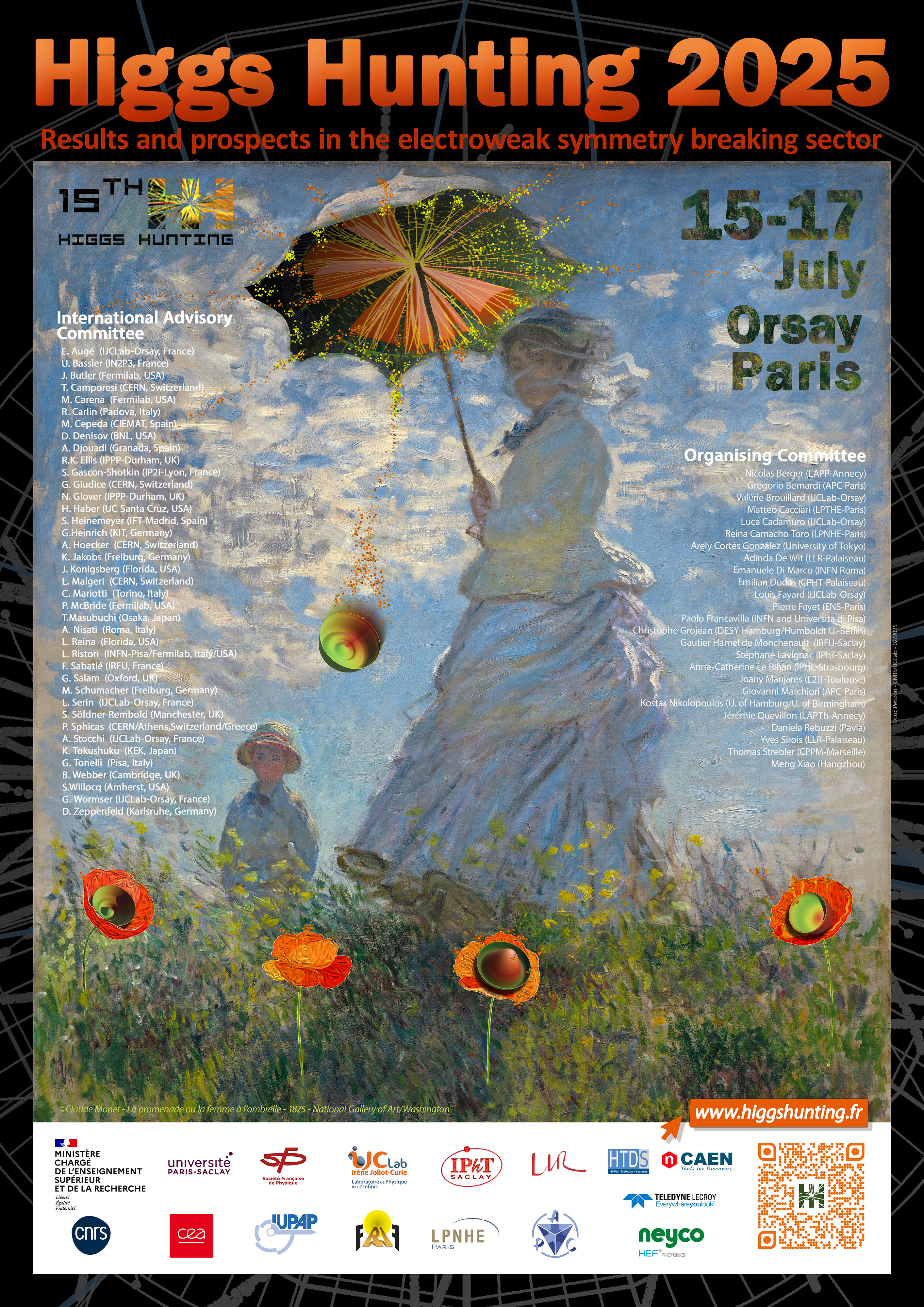
Higgs Hunting 2025
100/-1-A900 - Auditorium Joliot Curie
IJCLab
The origin of Electroweak symmetry breaking is one of the central topics of research in fundamental physics. The discovery of a Higgs boson at CERN on July 4th, 2012, following a hunt that spanned several decades and multiple colliders, changed the landscape of these investigations and provided key evidence for the Brout-Englert-Higgs mechanism of mass generation through the spontaneous breaking of Electroweak symmetry.
More than ten years later, the hunt goes on several fronts, in particular for:
- New physics through precision studies of the properties of the Higgs boson : in particular its mass, spin and couplings to other Standard Model particles.
- New production and decay modes, in particular in processes involving multiple Higgs bosons which provide key insight into the shape of the Higgs potential.
- New Higgs-like states and signals for physics beyond the Standard Model.
The 15th workshop of the « Higgs Hunting » series organized on July 15-17 2025 will present an overview of these topics, focusing in particular on new developments in the LHC Run-2 analyses, detailed studies of Higgs boson properties and possible deviations from Standard Model predictions. Highlights will also include a first look at LHC Run-3 analyses, prospects from studies at future colliders, and recent theoretical developments.
The workshop will be held in person in Orsay, for the first day, and Paris, for the two following days, to continue the Higgs Hunting tradition of lively discussions during and after the sessions. Remote participation will also be made possible for those unable to attend in person. No registration fees are asked for remote participation.
|
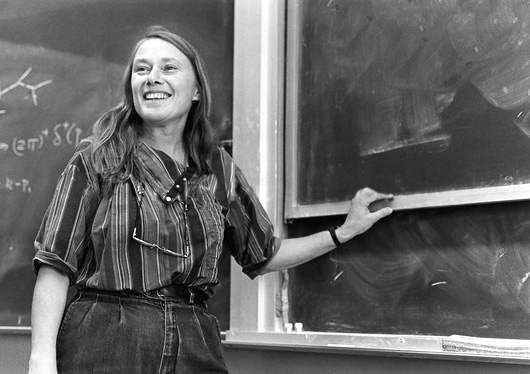
Mary K. Gaillard passed away on 23 May 2025. A major figure in particle theory, she made fundamental contributions to the establishment of the Standard Model. Notably, she achieved a successful determination of the charm quark mass from kaon decays; predicted three-jet events in e+ e- collisions, providing crucial evidence for the existence of gluons; and forecasted the bottom quark mass within the framework of unified theories. She also pioneered systematic studies of Higgs boson production and decay at particle colliders, sketching its first phenomenological profile that launched its experimental hunt. Beyond the Standard Model, Mary K. made numerous and invaluable contributions to Grand Unified Theories and supersymmetric theories, including work on proton decay, supersymmetry breaking, and effective supergravity theories derived from superstrings. The Higgs Hunting workshop was honored to welcome her in 2016 as the speaker for its traditional historical talkthan you can see in
Mary K. spent a substantial portion of her career in France and at CERN, from her doctoral studies in Orsay to the creation of the theoretical physics laboratory LAPTh in Annecy. The Higgs Hunting workshop extends its deepest condolences to her colleagues at the University of California, Berkeley, and to her family. |

![]() |
![]() |
![]() |
|
-
-
9:00 AM
→
9:55 AM
Registration (with coffee and croissants) 55m 100/-1-A900 - Auditorium Joliot Curie
100/-1-A900 - Auditorium Joliot Curie
IJCLab
IJCLab Orsay (Tuesday) & APC Paris (Wednesday & Thursday)140Show room on map -
9:55 AM
→
10:00 AM
Prelude from the organizers 5m 100/-1-A900 - Auditorium Joliot Curie
100/-1-A900 - Auditorium Joliot Curie
IJCLab
IJCLab Orsay (Tuesday) & APC Paris (Wednesday & Thursday)140Show room on map -
10:00 AM
→
10:45 AM
Plenary: Theory overview 100/-1-A900 - Auditorium Joliot CurieConvener: Nick Wardle (Imperial College)
-
10:00 AM
Theory overview 45mSpeaker: Thomas Gehrmann (Universität Zurich)
-
10:00 AM
-
10:45 AM
→
11:15 AM
Topical talks: Part 1 100/-1-A900 - Auditorium Joliot Curie
-
10:45 AM
Measurements of the Higgs boson mass and width in CMS 12mSpeaker: Neha Rawal (University of Florida)Abstract Ever since the discovery of the Higgs boson by the ATLAS and CMS Collaborations at LHC in 2012, precision measurements of its properties have been performed intensively. This is crucial for further understanding the Standard Model (SM) as well as to search for beyond the SM physics. This presentation focuses on precision measurements of the Higgs boson mass and total decay width performed using proton-proton collision data collected by the CMS detector during Run 2 of the LHC. It includes analysis strategies and techniques for precise and accurate measurement of the mass and discusses direct measurement of the width from the Higgs resonance peak. We also highlight studies on indirect width measurements which provide a better constraint on its value compared to direct measurements which are limited by the detector resolution.
-
10:57 AM
Constraining the Higgs boson width from Higgs-top Yukawa coupling at the ATLAS experiment 12mSpeaker: Yangfan Zhang (University of Science and Technology of China)
-
10:45 AM
-
11:15 AM
→
1:00 PM
Plenary: Higgs boson properties and couplings 100/-1-A900 - Auditorium Joliot CurieConvener: Nick Wardle (Imperial College)
-
11:15 AM
Higgs boson property measurements (mass, width, CP) - CMS 15mSpeaker: Amrutha Krishna (Northeastern University)
-
11:30 AM
Higgs boson property measurements (mass, width, CP) - ATLAS 15mSpeaker: Elise Le Boulicaut (Yale University)
-
11:45 AM
Higgs boson coupling measurements - CMS 15mSpeaker: Walaa Elmetenawee (Universita e INFN, Bari)
-
12:00 PM
Higgs boson coupling measurements - ATLAS 15mSpeaker: Fábio Lucio Alves (Nanjing University)
-
12:15 PM
Higgs boson properties and couplings - 3-slide overview 5mSpeaker: Nicholas Wardle (Imperial College London)
-
12:20 PM
Discussion of present status and prospects for coupling and property measurements 40m
-
11:15 AM
-
1:00 PM
→
2:30 PM
Lunch 1h 30m Bures cafeteria (Orsay)
Bures cafeteria
Orsay
-
2:30 PM
→
2:55 PM
Topical talks: Part 2 100/-1-A900 - Auditorium Joliot CurieConvener: Roberto SALERNO (LLR)
-
2:30 PM
Searches for Higgs coupling to charm quarks at the ATLAS experiment 12mSpeaker: Greta Brianti (Università di Trento)
-
2:42 PM
Search for H→cc at the CMS experiment 12mSpeaker: Angela Zaza (Univ. di Bari e Sez. dell'INFN)Abstract Probing the Higgs boson coupling to second generation quarks, still out of reach, is currently one of the most challenging goals of the CMS and ATLAS collaborations. The CMS collaboration carried out searches for the Higgs boson decay in a charm quark-antiquark pair with data collected during the Run-2 of the LHC (2016-2018), by exploring the Higgs boson associated production with a vector boson (VH) , the gluon fusion (ggF) and the associated production with a top quark-antiquark pair (ttH) production mechanisms. By combining the ttH and VH production mechanisms, CMS set the most stringent constraint to date on the Hcc Yukawa coupling modifier: |kc| < 3.5 (2.7). An overview on the searches for H→cc carried out by the CMS collaboration will be presented in this contribution.
-
2:30 PM
-
2:55 PM
→
3:25 PM
Plenary: The Higgs boson self-coupling and the electroweak phase transition 100/-1-A900 - Auditorium Joliot CurieConvener: Roberto SALERNO (LLR)
-
2:55 PM
Footprints of the Electroweak Phase Transition at Colliders 30mSpeaker: Oleksii Matsedonskyi (Cambridge University)
-
2:55 PM
-
3:25 PM
→
4:30 PM
Plenary: Higgs boson self-coupling and Di-Higgs production 100/-1-A900 - Auditorium Joliot CurieConvener: Roberto SALERNO (LLR)
-
3:25 PM
Higgs boson self-coupling and Di-Higgs production - ATLAS 15mSpeakers: Lorenzo Santi (CERN), Lorenzo santi (INFN - Roma1)
-
3:40 PM
Higgs boson self-coupling and Di-Higgs production - CMS 15mSpeakers: Leonidas Paizanos (University of Cyprus), Leonidas Paizanos (University of Cyprus)
-
3:55 PM
Higgs boson self-coupling and Di-Higgs production: 3-slide overview 5mSpeaker: Roberto SALERNO (LLR)
-
4:00 PM
Discussion of Higgs boson self-coupling and Di-Higgs production 30m
-
3:25 PM
-
4:30 PM
→
5:00 PM
Coffee break 30m 100/-1-A900 - Auditorium Joliot Curie
100/-1-A900 - Auditorium Joliot Curie
IJCLab
IJCLab Orsay (Tuesday) & APC Paris (Wednesday & Thursday)140Show room on map -
5:00 PM
→
5:30 PM
Plenary: Parton distribution functions 100/-1-A900 - Auditorium Joliot CurieConvener: Ben Kilminster (Universität Zürich)
-
5:00 PM
PDFs for Higgs boson processes at the LHC 30mSpeaker: Juan Rojo (Vrije Universiteit Amsterdam)
-
5:00 PM
-
5:30 PM
→
6:10 PM
Topical talks: Part 3 100/-1-A900 - Auditorium Joliot CurieConvener: Ben Kilminster (Universität Zürich)
-
5:30 PM
Model-independent differential measurement in H→WW at the CMS experiment 12mSpeaker: Benedetta Camaiani (Univ. di Firenze e Sez. dell'INFN)Abstract We present the differential measurement of H+jets in the WW decay channel using full run 2 CMS data. The measurements presented probe the CP nature of the Higgs boson couplings. A novel approach was used, exploiting adversarial neural network, to minimize model dependency of the measurement and allow reinterpretability. Constraints on several Wilson coefficients are also derived.
-
5:42 PM
Naturalness, near-criticality and future colliders 12mSpeaker: Víctor Enguita Vileta (Instituto de Física Teórica (IFT) UAM-CSIC)
-
5:54 PM
An Isotropic Prescription for Constructing the SMEFT in Normal Coordinates to Simplify Amplitude Computations 15mSpeaker: Mia West (University of Florida)
Geometry provides us with a convenient interpretation of field-redefinition invariance for amplitudes and has many useful properties. For instance, it directs us towards Riemann Normal Coordinates (RNC) as an ideal choice of field-redefinition to compute amplitudes. It has been shown in the Higgs Effective Field Theory (EFT) assuming custodial symmetry & in the high-energy limit in RNC there are distinct kinematics for each Feynman graph. Redefining the Lagrangian in these coordinates appears to generate a reduced set of Feynman graphs which still sum to the correct amplitude. This property also holds in the Standard Model EFT (SMEFT) as a subset of HEFT. In this talk, we will demonstrate a prescription to construct the SMEFT in RNC around the symmetric point using isotropy, applicable to all orders in the SMEFT expansion. Then, breaking electroweak symmetry corresponds to traversing a geodesic to the vacuum and re-establishing RNC in terms of isotropic properties of the symmetric point. We argue that this prescription is simpler compared to the usual recursive method to construct RNC.
-
5:30 PM
-
6:10 PM
→
7:00 PM
Historical talk 100/-1-A900 - Auditorium Joliot Curie
100/-1-A900 - Auditorium Joliot Curie
IJCLab
IJCLab Orsay (Tuesday) & APC Paris (Wednesday & Thursday)140Show room on mapConvener: Ben Kilminster (Universität Zürich)-
6:10 PM
Mysterious Neutrinos 50mSpeaker: Pierre Ramond (University of Florida)
-
6:10 PM
-
7:00 PM
→
8:30 PM
Welcome cocktail 1h 30m 100/-1-A900 - Auditorium Joliot Curie
100/-1-A900 - Auditorium Joliot Curie
IJCLab
IJCLab Orsay (Tuesday) & APC Paris (Wednesday & Thursday)140Show room on map
-
9:00 AM
→
9:55 AM
-
-
9:25 AM
→
10:00 AM
Coffee 35m LPNHE Paris
LPNHE Paris
-
10:00 AM
→
10:25 AM
Plenary: CMS Joker talk Amphithéâtre Charpak (LPNHE Paris)
Amphithéâtre Charpak
LPNHE Paris
Convener: Sven Heinemeyer (IFT/IFCA (CSIC))-
10:00 AM
CMS Joker talk: Search for anomalous Higgs couplings with H→γγ decays 25mSpeaker: Federica De Riggi (Univ. di Roma I e Sez. dell'INFN)
-
10:00 AM
-
10:25 AM
→
10:40 AM
Topical talks: Part 4 Amphithéâtre Charpak (LPNHE Paris)
Amphithéâtre Charpak
LPNHE Paris
-
10:25 AM
Search for CP violating effects in HWW vertex in WH production channel in 13 TeV pp collisions with the ATLAS detector 12mSpeaker: Ricardo Barrue (LIP - Laboratório de Instrumentação e Física Experimental de Partículas)
-
10:25 AM
-
10:40 AM
→
11:55 AM
Plenary: BSM H(125) aspects and searches for new scalar bosons Amphithéâtre Charpak (LPNHE Paris)
Amphithéâtre Charpak
LPNHE Paris
Convener: Sven Heinemeyer (IFT/IFCA (CSIC))-
10:40 AM
BSM H(125) aspects and searches for new scalar bosons - CMS 20mSpeaker: Siddhesh Sawant (Baylor University)
-
11:00 AM
BSM H(125) aspects and searches for new scalar bosons - ATLAS 20mSpeaker: Eleni Skorda (University of Birmingham)
-
11:20 AM
BSM H(125) aspects and searches for new scalar bosons: 3-slide overview 5mSpeaker: Sven Heinemeyer (IFT/IFCA (CSIC))
-
11:25 AM
Discussion of BSM H(125) aspects and searches for new scalar bosons 30m
-
10:40 AM
-
11:55 AM
→
1:05 PM
Lunch buffet 1h 10m LPNHE Paris
LPNHE Paris
-
1:05 PM
→
1:50 PM
Plenary: Analysis methods Amphithéâtre Charpak (LPNHE Paris)
Amphithéâtre Charpak
LPNHE Paris
Convener: Julie Malcles (CEA-Saclay/Irfu, Université Paris-Saclay)-
1:05 PM
Analysis methods - CMS 15mSpeaker: Maria Mazza (Florida State University)
-
1:20 PM
Analysis methods - ATLAS 15mSpeaker: Andrea Sciandra (UCSC)
-
1:35 PM
Analysis methods: 3-slide summary 5mSpeaker: Julie Malcles (CEA-Saclay/Irfu, Université Paris-Saclay)
-
1:40 PM
Discussion of analysis methods 10m
-
1:05 PM
-
1:50 PM
→
2:45 PM
Topical talks: Part 5 Amphithéâtre Charpak (LPNHE Paris)
Amphithéâtre Charpak
LPNHE Paris
Convener: Julie Malcles (CEA-Saclay/Irfu, Université Paris-Saclay)-
1:50 PM
Gauge-Higgs Unification and Symmetry Breaking: application to 5D GUTs 12mSpeaker: Wanda Isnard (IP2I Lyon)
-
2:02 PM
Search for Higgs boson decays into a pair of pseudoscalar particles in the yytautau final state using pp collisions at \sqrt{s} = 13 TeV with the ATLAS detector 12mSpeaker: Gadi Ninio (Tel Aviv University)
-
2:14 PM
Flavour Deconstructing the Composite Higgs 12mSpeaker: Marko Pesut (University of Zurich)
Abstract: In the first part of the talk, we will introduce the main model building ideas (flavour non-universality and Higgs compositeness) that are central to our model, as well as the theoretical and experimental motivations for exploring these BSM avenues. In the second part of the talk, we present a flavour non-universal extension of the Standard Model combined with the idea of Higgs compositeness. At the TeV scale, the electroweak gauge symmetry is assumed to act in a non-universal manner on light- and third-generation fermions, while the Higgs emerges as a pseudo Nambu-Goldstone boson of a spontaneously broken global symmetry. The flavour deconstruction implies that the couplings of the light families to the composite sector are suppressed by powers of a heavy mass scale, explaining the flavour puzzle. We present a detailed analysis of the radiatively generated Higgs potential, showing how this intrinsically-flavoured framework has the ingredients to justify the unavoidable tuning in the Higgs potential necessary to separate electroweak and composite scales. The model is compatible with current experimental bounds and predicts new states at the TeV scale, which are within the reach of near future experimental searches.
Arxiv: 2407.10950 -
2:26 PM
Search for a standard model-like Higgs boson in the mass range between 70 and 110 GeV in the diphoton final state in proton-proton collisions with CMS at √s=13 GeV 12mSpeaker: Benjamin Massoteau (IPN, IN2P3-CNRS, UCB Lyon 1)Abstract The results of a search for a standard model-like Higgs boson decaying into two photons in the mass range between 70 and 110 GeV are presented. The analysis uses the data set collected with the CMS experiment in proton-proton collisions from Run 2 at √s=13 TeV and part of the data set from Run 3, at √s=13.6 TeV. The expected and observed 95% confidence level upper limits on the product of the cross section and branching fraction for decays of an additional Higgs boson into two photons are presented.
-
1:50 PM
-
2:45 PM
→
3:15 PM
Plenary: VBS Amphithéâtre Charpak (LPNHE Paris)
Amphithéâtre Charpak
LPNHE Paris
Convener: Pamela Ferrari (Radboud University Nijmegen & Nikhef)-
2:45 PM
Vector boson scattering and the Higgs boson 30mSpeaker: Mathieu Pellen (University of Freiburg)
-
2:45 PM
-
3:15 PM
→
3:45 PM
Coffee break 30m LPNHE Paris
LPNHE Paris
-
3:45 PM
→
5:10 PM
Plenary: Effective field theories Amphithéâtre Charpak (LPNHE Paris)
Amphithéâtre Charpak
LPNHE Paris
Convener: Pamela Ferrari (Radboud University Nijmegen & Nikhef)-
3:45 PM
Effective field theories - theory overview 20mSpeaker: Jose SANTIAGO PEREZ (Universidad de Granada)
-
4:05 PM
Effective field theories - ATLAS 15mSpeaker: Elena Mazzeo (CERN)
-
4:20 PM
Effective field theories - CMS 15mSpeaker: Suman Chatterjee (Deutsches Elektronen-Synchrotron (DESY))
-
4:35 PM
Effective field theories: 3-slide overview 5mSpeaker: Pamela Ferrari (Radboud University Nijmegen & Nikhef)
-
4:40 PM
Discussion of EFT interpretations 30m
-
3:45 PM
-
5:10 PM
→
5:40 PM
Topical talks: Part 6 Amphithéâtre Charpak (APC Paris)
Amphithéâtre Charpak
APC Paris
Convener: Pamela Ferrari (Radboud University Nijmegen & Nikhef)- 5:10 PM
-
5:25 PM
The Higgs meets the SMEFT at higher orders 15mSpeaker: Dr Stefano Di Noi (KIT (ITP))
-
5:40 PM
→
6:20 PM
Plenary: Vision talk Amphithéâtre Charpak (LPNHE PAaris)
Amphithéâtre Charpak
LPNHE PAaris
Convener: Pamela Ferrari (Radboud University Nijmegen & Nikhef)-
5:40 PM
Vision talk: Higgs physics and Early Universe cosmology 35mSpeaker: Alfredo URBANO (Sapienza University of Rome and INFN)
-
5:40 PM
-
6:59 PM
→
7:00 PM
Dinner information 1m 100/-1-A900 - Auditorium Joliot Curie
100/-1-A900 - Auditorium Joliot Curie
IJCLab
IJCLab Orsay (Tuesday) & APC Paris (Wednesday & Thursday)140Show room on map -
7:00 PM
→
11:00 PM
Dinner 4h "Capitaine Fracasse" river barge
"Capitaine Fracasse" river barge
Departure from "Ile aux cygnes" (RER station "Champ de Mars Tour Eiffel", métro station "Bir-Hakeim")
Boarding at 20:15, return at 23:00
-
9:25 AM
→
10:00 AM
-
-
9:30 AM
→
10:00 AM
Coffee 30m LPNHE Paris
LPNHE Paris
-
10:00 AM
→
10:25 AM
Plenary: ATLAS Joker talk Amphithéâtre Charpak (LPNHE Paris)
Amphithéâtre Charpak
LPNHE Paris
Convener: Karl Jakobs (University of Freiburg))-
10:00 AM
ATLAS Joker talk: Recent results of searches for Higgs boson decays with the ATLAS detector 25mSpeaker: Stefano Manzoni (CERN)
-
10:00 AM
-
10:25 AM
→
12:45 PM
Plenary: Higgs physics within the European strategy update Amphithéâtre Charpak (LPNHE Paris)
Amphithéâtre Charpak
LPNHE Paris
Convener: Karl Jakobs (University of Freiburg)-
10:25 AM
Challenges in Theory Predictions 25mSpeaker: Federico Buccioni (TUM)
-
10:50 AM
Accelerators overview 25mSpeaker: Frank Zimmermann (CERN)
-
11:15 AM
Overview of the ESPPU strategy for Higgs and Electroweak physics and introduction to the discussion 20mSpeakers: Gregorio BERNARDI (APC-Paris CNRS/IN2P3), gregorio bernardi (lpnhe)
-
11:35 AM
Discussion 1h 10m
-
10:25 AM
-
12:45 PM
→
2:15 PM
Lunch buffet 1h 30m LPNHE Paris
LPNHE Paris
-
2:15 PM
→
2:45 PM
Plenary: Toponium Amphithéâtre Charpak (LPNHE Paris)
Amphithéâtre Charpak
LPNHE Paris
Convener: Florencia Canelli (Universität Zürich)-
2:15 PM
Toponium formation at the Large Hadron Collider 30mSpeaker: Prof. Benjamin Fuks (LPTHE / Sorbonne U.)
-
2:15 PM
-
2:45 PM
→
4:15 PM
Plenary: Concluding talks Amphithéâtre Charpak (LPNHE Paris)
Amphithéâtre Charpak
LPNHE Paris
Convener: Florencia Canelli (Universität Zürich)-
2:45 PM
Theory concluding talk 45mSpeaker: Gavin Salam (University of Oxford, Department of Physics and All Souls College)
-
3:30 PM
Experimental concluding talk 45mSpeaker: Maria Cepeda (CIEMAT)
-
2:45 PM
-
4:15 PM
→
5:15 PM
Farewell coffee 1h LPNHE Paris
LPNHE Paris
-
9:30 AM
→
10:00 AM
Mary K. Gaillard passed away on 23 May 2025. A major figure in particle theory, she made fundamental contributions to the establishment of the Standard Model. Notably, she achieved a successful determination of the charm quark mass from kaon decays; predicted three-jet events in e+ e- collisions, providing crucial evidence for the existence of gluons; and forecasted the bottom quark mass within the framework of unified theories. She also pioneered systematic studies of Higgs boson production and decay at particle colliders, sketching its first phenomenological profile that launched its experimental hunt. Beyond the Standard Model, Mary K. made numerous and invaluable contributions to Grand Unified Theories and supersymmetric theories, including work on proton decay, supersymmetry breaking, and effective supergravity theories derived from superstrings. The Higgs Hunting workshop was honored to welcome her in 2016 as the speaker for its traditional historical talk